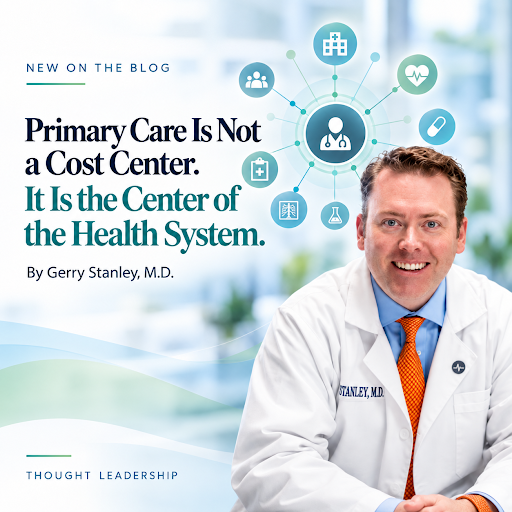
I often describe myself simply as a rural family doctor.
My career has taken me well beyond the walls of a family medicine practice. I have spent more than 20 years in clinical practice and executive leadership, working across population health, employer health, health plans, digital health and healthcare transformation. But I still tend to view the healthcare system through the same lens I developed in primary care: What happens to the patient next?
That question matters more than ever.
Primary care physicians are often discussed in one of two ways. In conversations about value-based care, they are viewed as the front line of prevention, chronic disease management and cost containment. In conversations about health system growth, they are viewed as referral sources, the clinicians who connect patients to specialists, procedures and hospital services.
The mistake is believing those are competing ideas.
They are not.
Great primary care can improve outcomes, reduce unnecessary spending and strengthen the specialty networks that health systems depend on. In fact, those objectives should reinforce one another.
The Most Important Intersection in Healthcare
For most patients, primary care is where healthcare becomes real.
It is where hypertension is caught before it becomes a stroke. Where an abnormal screening leads to an early cancer diagnosis. Where diabetes is managed before it progresses to kidney failure. Where a physician recognizes that the nagging shortness of breath requires a cardiology evaluation or that persistent knee pain has reached the point where an orthopedic specialist should become involved.
Research supports the broader value of that relationship. A nationally representative JAMA Internal Medicine study found that adults with primary care received more high-value services, including preventive and cancer screening services, and reported better access and healthcare experiences than adults without primary care.
That is the clinical argument for primary care.
It is also the foundation of the economic argument.
Healthcare is moving, sometimes slowly and imperfectly, toward models in which systems are increasingly responsible for the total health and total cost of a population. Value-based payment models have therefore placed considerable emphasis on primary care because prevention, continuity, disease management and coordination offer opportunities to improve outcomes while avoiding unnecessary utilization.
But primary care does something else that healthcare organizations sometimes hesitate to talk about.
It determines where a tremendous amount of healthcare goes next.
Every Referral Is a Clinical Decision, and a Network Decision
When a family physician determines that a patient needs care beyond the scope of primary care, that decision can begin an entire episode of care.
A suspicious mammogram becomes oncology, surgery, pathology, radiation therapy and potentially years of follow-up.
Chest discomfort can become cardiology, advanced imaging, catheterization or cardiovascular surgery.
Progressive hip or knee pain can become imaging, physical therapy, orthopedic consultation and ultimately joint replacement.
The referral itself may look like a small event in an electronic medical record. The downstream consequences are anything but small.
Researchers have described referrals as a potential “linchpin” of value-based care because they influence coordination, utilization and spending across the healthcare system. More recent research also demonstrates just how strongly primary care relationships can influence where specialty care occurs. One large study found that when PCPs became vertically affiliated with health systems, specialist utilization within those systems increased significantly.
That does not mean the goal should simply be to “keep referrals in the system.”
The goal should be to create a network that is so clinically connected, accessible and effective that keeping the patient within it is frequently the best choice for the patient.
That distinction is important.
We Should Stop Asking Primary Care to Choose Between Value and Growth
Health systems have historically struggled with an uncomfortable financial contradiction.
Primary care is cognitively intensive, relationship-driven medicine. It takes time. It requires coordination. And under traditional fee-for-service reimbursement, much of that work has been compensated differently, and often less generously than procedure-oriented specialty care.
The Commonwealth Fund has highlighted that tension directly: primary care practices are being asked to lead value-based transformation while traditional economics continue to reward many specialty and hospital-based services more heavily.
That can create two very different conversations inside the same organization.
One group asks:
How can primary care reduce utilization?
Another asks:
How can primary care drive specialty growth?
I would argue that we are asking the wrong question.
The better question is:
How can primary care ensure that every patient receives the right care, at the right time, in the right setting, from the right clinician?
Sometimes the answer is prevention.
Sometimes it is managing the patient successfully within primary care.
Sometimes it is avoiding an unnecessary emergency department visit, or duplicative test or procedure.
And sometimes the right answer is absolutely a cardiologist, oncologist, orthopedic surgeon or another specialist.
Those specialty services also matter enormously to the financial sustainability of health systems. Procedural areas such as cardiology and orthopedics, for example, have traditionally been closely scrutinized for their contribution margins, although health systems increasingly recognize that true profitability has to incorporate the full cost of delivering that care rather than simply procedure revenue.
In an environment where health system operating margins have recently hovered around 1%, leaders cannot afford to misunderstand either side of that equation.
Primary care can help prevent expensive, unnecessary care and appropriately connect patients to high-value specialty care when it is needed.
Those are not opposing strategies.
That is what a functioning healthcare network is supposed to do.
The Problem Is Visibility
There is another problem I have seen throughout healthcare: organizations frequently do not understand how their own networks actually behave.
A health system may employ hundreds of primary care physicians and hundreds more specialists and assume those clinicians collectively operate as an integrated network.
But organizational charts are not patient journeys.
Where are patients actually going after they see a PCP?
Which cardiologists are receiving referrals?
Which orthopedic groups?
Which oncologists?
Are patients reaching the specialists best equipped to treat them?
Are appointments available?
Are certain communities routinely leaving the network for care?
Are referral patterns driven by clinical relationships, historical habit, patient preference, geography or access?
And when patients leave the system, does anyone understand why?
That visibility becomes particularly important in value-based care. Research involving Medicare ACOs has shown substantial movement of specialty care outside patients' attributed organizations, illustrating how difficult it can be for a health system to manage outcomes and costs when it cannot see or influence the complete patient journey.
This is where I believe healthcare has an enormous opportunity.
Not to dictate referrals.
Not to reduce medicine to a financial transaction.
But to give physicians and health system leaders better information about the networks surrounding their patients.
This is one of the reasons I have been interested in the work Doctivity Health is doing around network intelligence and physician relationship visibility. The value is not simply in showing where referrals are going. It is in helping health systems better understand how patients move through their networks, where relationships are strong, where access or continuity may be breaking down, and where there are opportunities to improve both care coordination and organizational performance. Better visibility does not replace clinical judgment. It gives clinicians and leaders better information with which to exercise it.
Network Integrity Is Ultimately About the Patient
The phrase network integrity can sound like healthcare business terminology.
I think it should mean something much simpler.
When I refer a patient to another physician, can I trust that the next part of that patient's journey will be connected to the first?
Will the specialist understand what happened before the referral?
Will I know what happened afterward?
Will the patient get an appointment?
Will someone recognize if the patient never schedules it?
Will we know if the patient ends up receiving care somewhere completely different?
Those sound like basic questions.
Healthcare still struggles to answer them.
Even communication between primary care and specialty medicine has historically been inconsistent. Research has documented significant gaps between how frequently PCPs believe they send relevant referral information and how frequently specialists report receiving it, and similar gaps in communication back to primary care after the consultation.
Technology has given healthcare extraordinary amounts of data.
The next challenge is turning that data into visibility.
Because once we can see how patients actually move through healthcare, we can begin asking much better questions.
Where are we losing continuity?
Where are patients experiencing unnecessary friction?
Where are there access problems?
Where are strong physician relationships producing excellent outcomes?
Where should we invest?
And where can earlier intervention in primary care prevent the patient from needing more intensive care altogether?
The Front Door Is Also the Foundation
I have spent enough of my career in healthcare to be skeptical whenever someone presents a complicated problem with a simple answer.
Primary care will not solve every problem in American healthcare.
But I am convinced that we will not solve many of our biggest problems without it.
If we want value-based care, we need strong primary care.
If we want better prevention, we need strong primary care.
If we want coordinated specialty care, we need strong primary care.
If health systems want to understand and strengthen their physician networks, they need to understand what happens in primary care.
And if they want sustainable growth, they should pay very close attention to the physicians who are helping patients decide where their healthcare journey goes next.
For too long, healthcare organizations have treated primary care as either a cost-containment strategy or a growth strategy.
It is both.
More importantly, it is the connective tissue between them.
When we strengthen that connection, and give physicians better visibility into the networks around them, we create an opportunity to do something healthcare desperately needs:
Deliver better care for the patient while building a more sustainable healthcare system.
About Gerry Stanley, M.D.
Dr. Gerry Stanley serves on the Doctivity Health Advisory Board, bringing more than 20 years of clinical practice and executive leadership experience across healthcare transformation, population health, employer health, health plans and digital health. A third-generation family physician and Fellow of the American Academy of Family Physicians, Dr. Stanley currently serves as Chief Medical Officer of Express Scripts PBM by Evernorth and has previously held senior clinical leadership roles at Cerner and Harvard MedTech. His perspective as both a practicing physician and healthcare executive helps inform Doctivity’s work around network integrity, value-based care, physician relationships and the evolving role of primary care in building stronger, more connected healthcare systems.





.svg)